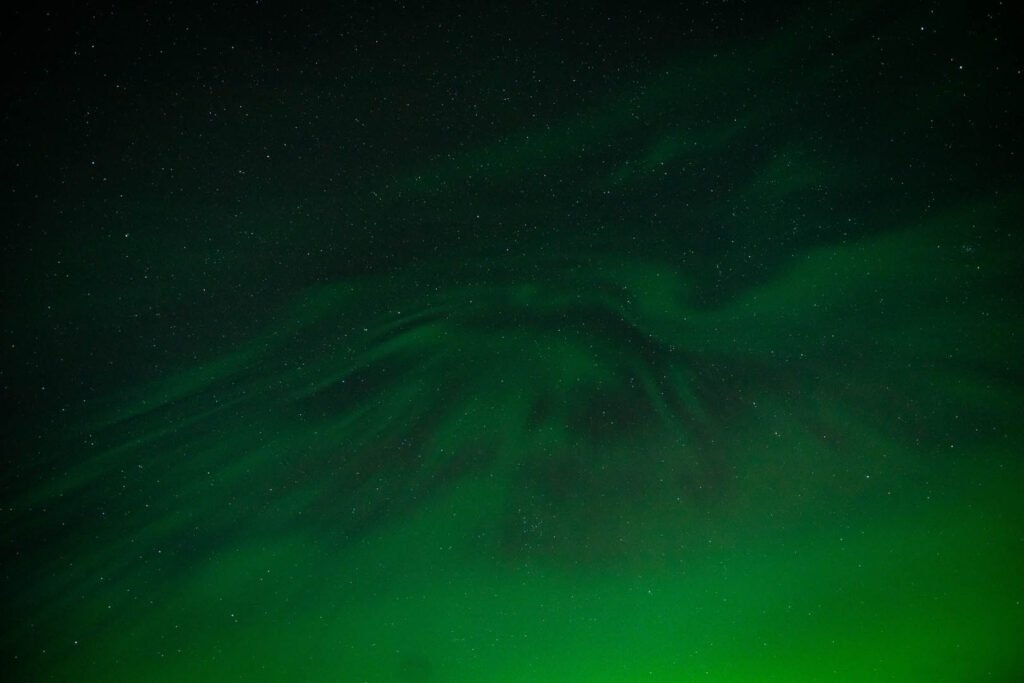
Iceland lies just south of the Arctic Circle, right under the auroral oval, so you don’t need to drive far: you need darkness and a gap in the clouds. Solar Cycle 25 reached its maximum period in October 2024, and the years around a maximum bring more frequent and stronger displays (NASA and NOAA), so winter 2026–27 is still a good season. The real risk on a self-drive aurora night isn’t the cold. It’s the road. Here’s how to plan the night, where to park, and how to get a sharp photo.
How to read the forecast
- Clouds matter most. On the Icelandic Met Office aurora forecast, the map shows cloud cover: green areas are cloudy, white areas are clear. Look for a white patch within an hour’s drive and check it again around 18:00.
- Activity is a number from 0 to 9. It’s shown in the corner of the same page. Near Reykjavík, a clear and dark sky with activity around 2–3 is often enough to see something; higher numbers mean brighter, faster movement.
- Darkness: the season runs from late August to mid-April, with the longest nights from November to January. The same page gives sunset, darkness and moonrise times for Reykjavík. A full moon brightens the sky and washes out weak aurora.
- Weather and roads: check the wind and road conditions on vedur.is and umferdin.is before you leave. Clear winter nights are usually the coldest, so expect ice.
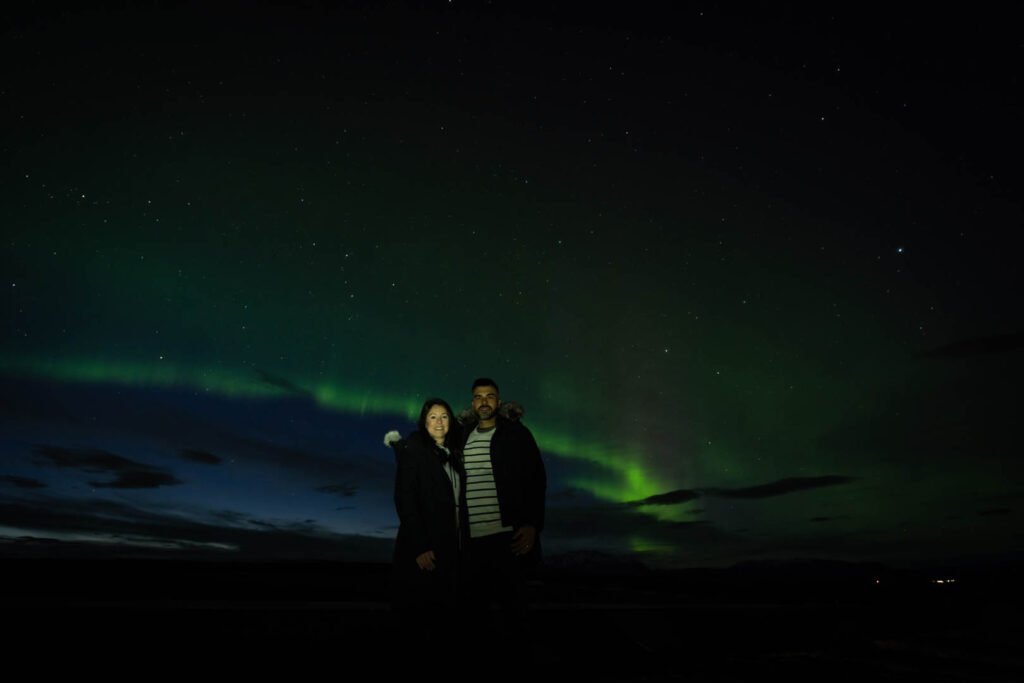
Six dark spots near Reykjavík with safe parking
All six are on paved roads, so any rental car will do in good conditions. Not got one yet? We recommend Reykjavik Cars and, for campervans, Motorhome Iceland. More options on our car rental page.
1. Grótta lighthouse, Seltjarnarnes (15 min)
The darkest place you can reach inside the capital area, at the tip of Seltjarnarnes. Park at the lighthouse car park and walk to the shore; the island itself is only reachable at low tide. The city’s glow still lights up the sky to the east, so this works best on strong nights. The small Kvika foot bath by the shore is free (Iceland Travel Guide, October 2026). It gets busy on clear nights, so come early.
2. Hvaleyrarvatn, Hafnarfjörður (20–25 min)
A small lake in the lava hills behind Hafnarfjörður, with a car park at its west end. It’s darker than Grótta and a quick escape if the forecast changes. Free parking.
3. Kleifarvatn, Route 42 (35 min)
A large lake in a rift valley on the Reykjanes peninsula, with no lights around it and a black sand shore that makes a good foreground. Use the car park by the lake, not the lay-bys on the narrow road. Route 42 over the Vatnsskarð pass can be icy and is sometimes closed in winter. Free parking. More about the area in our Reykjanes geology road trip.
4. Raufarhólshellir car park, Route 39 (35–45 min)
The car park of the lava tunnel by the Þrengsli road is a handy, easy stop: wide open lava fields and few lights. You’re there for the sky, not the cave, so keep away from the cave entrance in the dark.
5. Þingvellir National Park (45–50 min)
The best sky near the capital, and the most famous. Park only in the marked car parks: one 1,000 ISK ticket covers all of them for the day (Go Campers). The visitor centre closes in the evening, but the car parks stay open. On clear nights in peak season they fill up, so plan a backup.
6. Garðskagi lighthouse, Reykjanes (about 1 hour)
Two lighthouses at the north-west tip of the peninsula, with open sea to the north. It’s 15 minutes from Keflavík airport, so it fits a first or last night. Free parking.
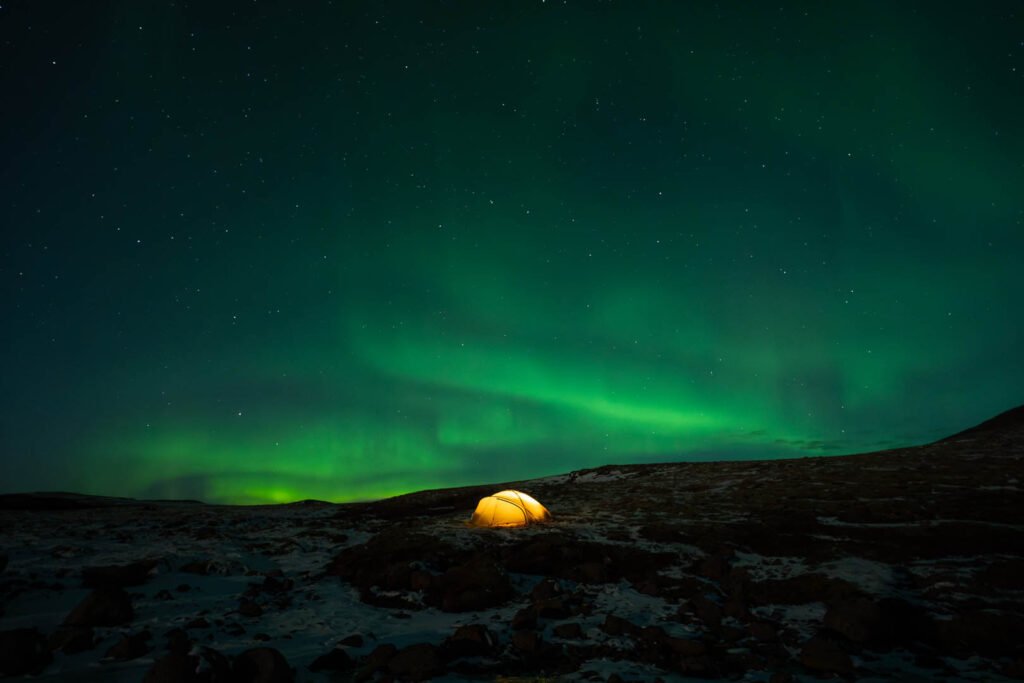
Safety on the road: what goes wrong
Every winter the police and Safetravel warn about aurora chasers who stop in the middle of the road or on the shoulder. A parked car is hard to see at night, and Safetravel says this “may result in a fine or an accident” (Safetravel, October 2026).
- Never stop on the road or the shoulder, even “just for a second”. Drive on to the next car park or turn back.
- Don’t watch the sky while you drive. If the lights start while you’re on the road, let the passenger watch and find a safe place to stop.
- Turn your headlights off in the car park. It keeps the sky dark for everyone, but don’t walk on the road to take pictures.
- Expect black ice. Clear nights are cold, and car parks are often the iciest ground. Wear shoes with grip or microspikes.
- Hold the car door with both hands in wind. Wind damage to doors is a common and expensive rental claim.
- Go with a full-enough tank and a charged phone, and tell someone where you’re going. The emergency number is 112.
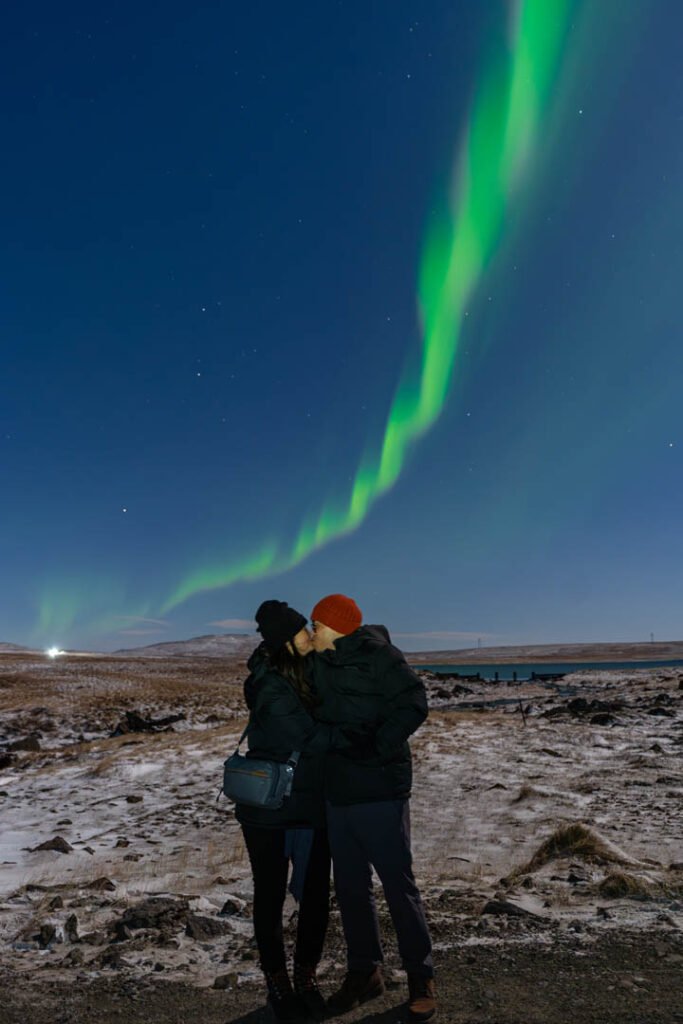
Camera settings that work
- Tripod first. You’ll be shooting for several seconds at a time, so the camera has to stand still. Use the 2-second timer or a remote.
- Starting point: ISO 1600–3200, the widest aperture you have (f/2.8 or wider), 5–15 seconds. Use shorter times when the aurora moves fast, and up to 20–25 seconds when it’s faint.
- Focus by hand. Autofocus fails in the dark. Switch to manual, zoom in on a bright star or distant light in live view and turn the ring until it’s a sharp point.
- Shoot RAW and set white balance to about 3500–4000 K, so the green looks natural.
- On a phone: use night mode, lean the phone on something solid, and keep exposures at 3–10 seconds.
- Keep batteries warm in an inside pocket. Cold drains them fast.
When to take a guided tour
A self-drive aurora night is easy when the sky is clear close to town. A guide makes sense when:
- The clear sky is far away. Guides read the cloud forecast for a living and know which valleys clear first. Driving 1–2 hours on dark, icy roads after a long day is where accidents happen.
- You don’t want to drive in winter. Wind, ice and darkness on unfamiliar roads are a lot to handle, especially if you’re used to driving on the other side.
- You want photos of yourself under the aurora. Our guide sets up the camera and takes the pictures, so you can watch instead of fiddling with settings.
Northern Lights with Zimno
- Northern Lights Private Tour with Photographer: about 4 hours with hotel pickup at 21:00, by SUV (up to 4) or van (up to 15). We check the forecast every day and drive to where the sky is clearest. Hot drinks, parking and a photo package (5 photos per person) included. Runs September to April. From 159,000 ISK.
- Tailored Private Adventure Tour: combine a winter day trip with an evening aurora hunt.
Every tour can be guided in English or in Polish. See all our tours.
Before you go: a 1-minute checklist
- Check the cloud map on vedur.is around 18:00 and again before you leave
- Check the roads on umferdin.is
- Choose a car park, plus a backup in another direction
- Pack warm layers, a hat, gloves and a hot drink
- Bring a headlamp with a red light, a tripod and spare batteries
- Shoes with grip or microspikes for icy car parks
- Never stop on the road or shoulder: drive on to the next car park
The six spots at a glance
| Spot | From Reykjavík | Parking (ISK) | Good for |
|---|---|---|---|
| Grótta lighthouse | 15 min | Free | Strong nights, no long drive |
| Hvaleyrarvatn | 20–25 min | Free | A darker sky close to town |
| Kleifarvatn | 35 min | Free | Dark sky, lake foreground |
| Raufarhólshellir car park | 35–45 min | Car park by the cave | Open lava fields, easy stop |
| Þingvellir | 45–50 min | 1,000 per day | The darkest sky near the capital |
| Garðskagi lighthouse | About 1 hour | Free | First or last night near the airport |
FAQ
Can I see the Northern Lights by myself with a rental car?
Yes. Pick a clear night on the vedur.is cloud map, drive 15–50 minutes out of Reykjavík to a dark car park such as Kleifarvatn or Þingvellir, and watch from there. Never stop on the road or the shoulder.
Where can I see the Northern Lights near Reykjavík?
Grótta lighthouse (15 min), Hvaleyrarvatn (20–25 min), Kleifarvatn (35 min), the Raufarhólshellir car park on Route 39 (35–45 min), Þingvellir (45–50 min) and Garðskagi lighthouse (about 1 hour).
When is the Northern Lights season in Iceland?
From late August to mid-April. The nights are longest from November to January, and the best hours are roughly 21:00–01:00.
What aurora forecast number do I need?
On the vedur.is scale from 0 to 9, activity of 2–3 is often enough near Reykjavík if the sky is clear and dark. Cloud cover matters more than the number.
What camera settings should I use for the Northern Lights?
Use a tripod, ISO 1600–3200, f/2.8 or wider and 5–15 seconds, with focus set by hand to infinity. On a phone, use night mode and rest the phone on something solid.
Do I need a 4×4 to chase the Northern Lights?
No. All six spots in this guide are on paved roads. In winter, choose a car with good winter tyres and check umferdin.is before you leave.